Abstract
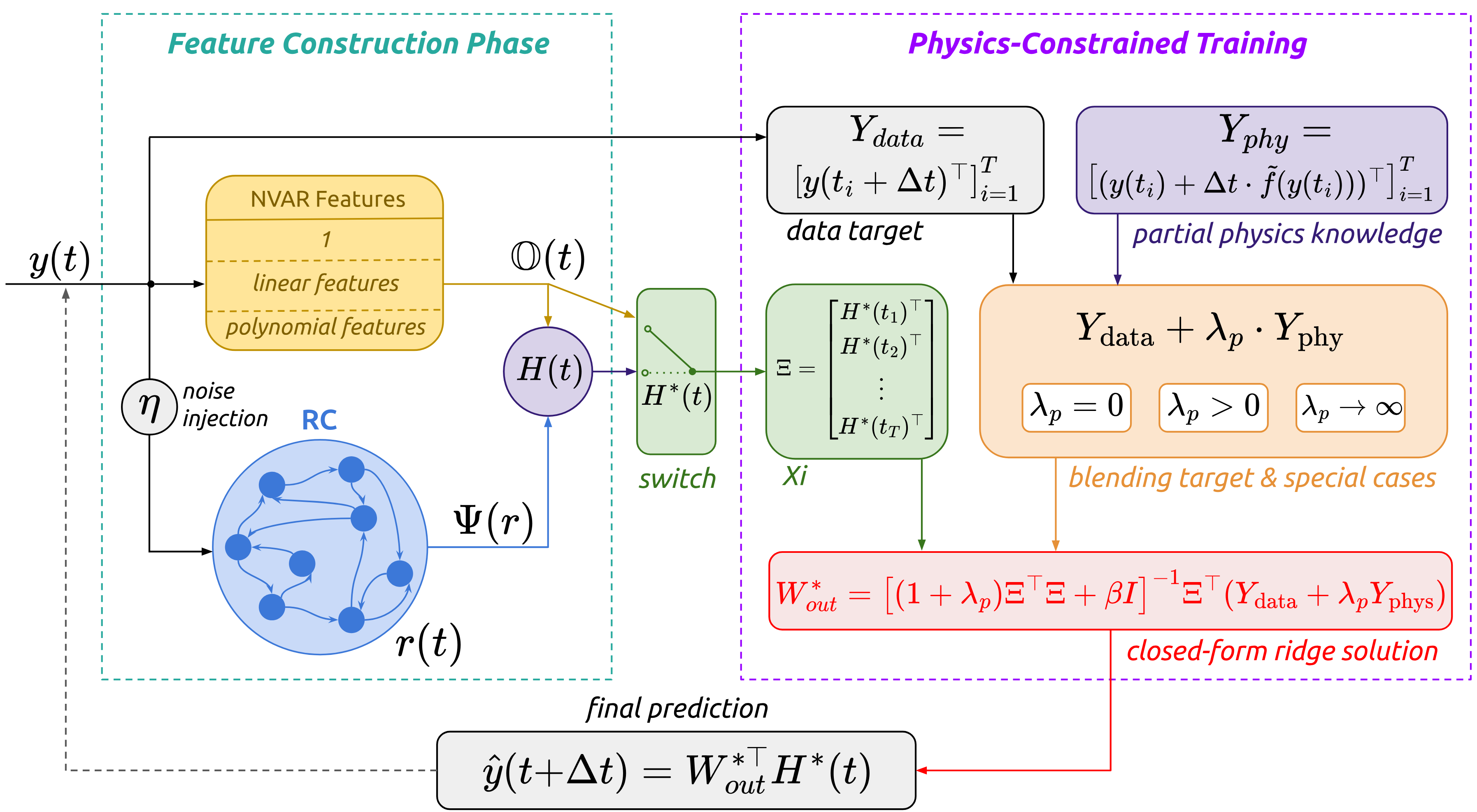
Accurate state-of-health estimation of lithium-ion batteries is critical for the safe operation of electric vehicles, yet deploying high-fidelity prognostic models on a vehicle’s onboard battery management system is often challenging due to limited computational resources. To address this challenge, we propose a novel, lightweight physics-informed reservoir computing (PIRC) framework that integrates physical degradation priors directly into a closed-form ridge regression readout. PIRC employs an adaptive switching mechanism that autonomously selects the optimal feature representation, mitigating over-parameterization instability while strictly minimizing the number of necessary trainable parameters. We demonstrate PIRC’s effectiveness on the NASA PCoE battery dataset and benchmark chaotic systems, achieving lower mean error with fewer trainable readout weights, resulting in lower computational overhead than standard physics-informed neural networks and existing hybrid reservoir models.
Architecture
Citation
Anurag, Kumar, Yanwen Xu, and Wenbin Wan. “Lightweight Physics-Informed Reservoir Computing for Battery Health Prediction.” Accepted to the IFAC Conference on Modeling, Estimation and Control (MECC 2026).
@inproceedings{ANURAG2026PIRC,
title = {Lightweight Physics-Informed Reservoir Computing for Battery Health Prediction},
booktitle = {IFAC Conference on Modeling, Estimation and Control (MECC 2026)},
year = {2026},
note = {Accepted},
author = {Kumar Anurag and Yanwen Xu and Wenbin Wan}
}